
If you’d rather listen than read, feel free to play the audio file below for the rest of this article.
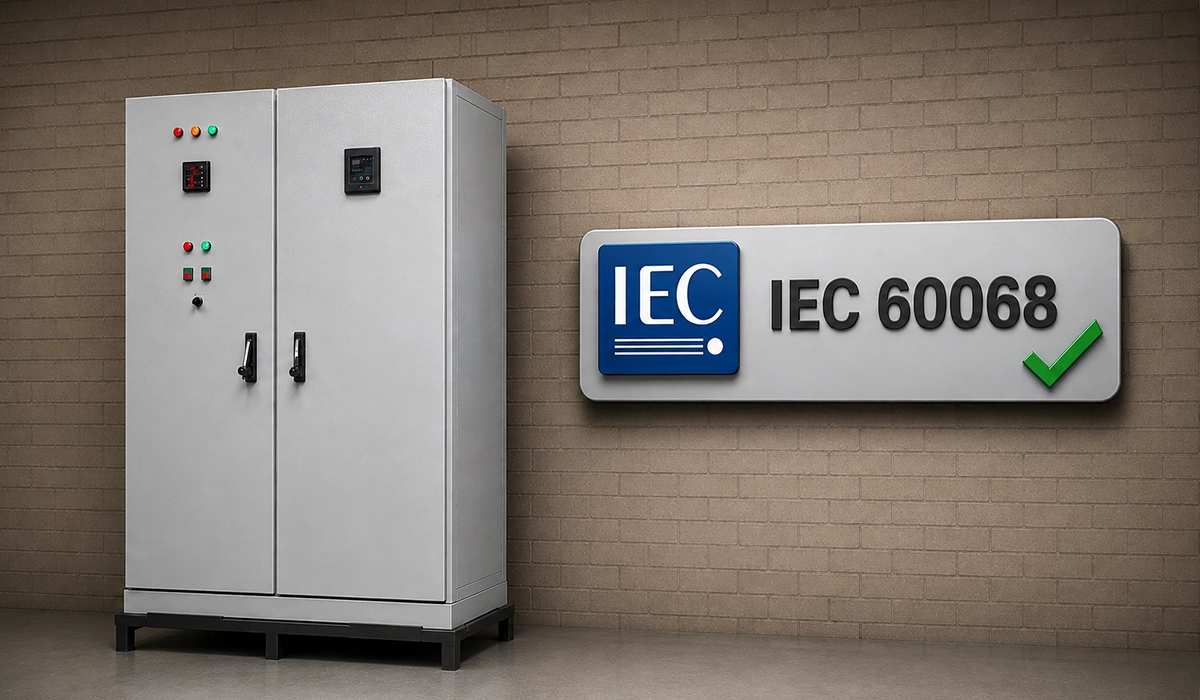
What Is IEC 60068? Structure and Scope of the Standard
The standard is built on a three-part architecture. Part 1 covers general principles, terminology, and standard atmospheric conditions. Part 2 contains the test methods, each in its own sub-part. Part 3 provides rationale and guidance for selecting and applying them.
Its scope covers electrotechnical products and their components: circuit boards, connectors, enclosures, power supplies, and assemblies. It defines the environmental stress testing electronics face in service. Among climatic testing standards it is the most widely referenced, and the mechanical testing standards IEC publishes here cover vibration and shock.
One point is routinely misunderstood. IEC 60068 does not specify which tests a product must pass. That comes from the product standard, the customer specification, or an assessment of the application environment. Treating it as a checklist invites two failure modes: applying conditions that misrepresent the service environment, and confusing climatic, mechanical, and combined categories.
Because the series deliberately stops short of naming which tests apply, that decision falls to the product standard governing the equipment. For distribution assemblies, the framework set out in switchgear and busbar standards is the natural starting point before any environmental test plan is drafted.
IEC 60068-1—General Principles and Terminology
Part 1 establishes the vocabulary the rest of the series depends on. The equipment under test, or EUT, is the item subjected to the stress. Test severity is the combination of level and duration selected for a given test. Conditioning is the period of exposure itself, while recovery is the interval afterwards during which the EUT returns towards reference conditions before assessment.
Part 1 also prescribes standard atmospheric conditions for measurement. A reading taken immediately after exposure and one taken after full recovery can differ substantially. That distinction separates reversible degradation from permanent damage, and belongs explicitly in any test plan.
A word such as severity carries one meaning here and a slightly different one elsewhere, which causes more specification disputes than most engineers expect. Our electrical standards guide is worth reading alongside Part 1, since it maps how the main standards families define and share their vocabulary.
IEC 60068-2—The Test Method Sub-Series
Each sub-part of IEC 60068-2 addresses one specific type of environmental stress and carries its own test letter. Test A is cold, Test B is dry heat, Test Ca and Cab cover damp heat steady state, and Test Db is damp heat cyclic. Vibration and shock use the F and E letters respectively.
For offline reading, you can download the complete document from this link.
Reading a designation is straightforward once the convention is clear. IEC 60068-2-30 identifies the sub-part, and Test Db identifies the method within it. Specifications commonly cite both, since the letter alone is ambiguous across editions.
These sub-parts apply to components just as much as to finished units, so cabling and interconnects are conditioned under the same test letters. The construction differences between wires and cables often determine which climatic and mechanical stresses are worth applying in the first place.
IEC 60068-3—Guidance and Background Information
Part 3 documents are not test methods. They explain why a test exists, what failure mechanism it targets, and how to choose conditions that represent a real environment. The IEC 60068-3-1 background information guide covers cold and dry heat testing in this way, and its counterparts do the same for other stress types.
For engineers writing test plans, or for organisations setting internal qualification standards, these documents carry more practical value than the test methods themselves.
The principle of guidance standing apart from requirements appears in hazardous-area work as well. The comparison of ATEX and IECEx shows how two schemes can share almost identical technical content while differing entirely in the route to acceptance.
Key IEC 60068 Test Methods—What Each Test Covers
The table below summarises the sub-parts most often cited in qualification programmes, with representative parameters. Actual severities come from the applicable product standard or specification, not from the ranges shown here.
| IEC 60068 Part | Test Letter | Test Type | Typical Parameters | Applications |
|---|---|---|---|---|
| IEC 60068-2-1 | Test A | Cold | -10 °C to -65 °C, 16–72 Hours | Outdoor Equipment, Storage Qualification |
| IEC 60068-2-2 | Test B | Dry Heat | +40 °C to +125 °C, 16–72 Hours | Industrial Electronics, Power Supplies |
| IEC 60068-2-6 | Test Fc | Sine Vibration | 10–2000 Hz, 0.15–10 g, 1 Oct/Min Sweep | Avionics, Rail, Industrial |
| IEC 60068-2-11 | Test Ka | Salt Mist | 5% NaCl, 35 °C, 16–96 Hours | Coastal and Marine Electronics |
| IEC 60068-2-13 | Test M | Low Air Pressure | Down to 11.5 kPa (40,000 Ft) | Avionics, High-Altitude Equipment |
| IEC 60068-2-14 | Test N | Thermal Shock | -55 °C to +125 °C, 5-Min Transfer, 5 Cycles Min | Automotive, Defence, Aerospace |
| IEC 60068-2-18 | Test R | Water | Drip, Splash, Immersion | Outdoor, Marine |
| IEC 60068-2-27 | Test Ea | Shock | Half-Sine, 15–1000 g, 0.5–18 Ms | Transport, Defence, Handheld |
| IEC 60068-2-30 | Test Db | Damp Heat Cyclic | 25–55 °C, 93% RH, 12/12-Hour Cycle | Tropical Environments, HVAC |
| IEC 60068-2-38 | Test Z/AD | Combined Temp/Humidity Cyclic | -10 °C to +65 °C, 93% RH | Automotive, Industrial |
| IEC 60068-2-52 | Test Kb | Salt Mist Cyclic | 5% NaCl, 4 Cycles of 2 H Wet + 22 H Recovery | Marine, Coastal Infrastructure |
| IEC 60068-2-60 | Test Ke | Corrosive Mixed Gas | H₂S, SO₂, NO₂, Cl₂; 25 °C/75% RH, 10–21 Days | Telecom, Industrial Process |
| IEC 60068-2-64 | Test Fh | Random Vibration | Broadband PSD 20–2000 Hz, 0.04–0.1 g²/Hz | Defence, Aerospace, Automotive |
| IEC 60068-2-68 | Test L | Dust and Sand | Fine Dust 2 g/m³ or Coarse Sand 2.7 g/m³ | Desert, Construction, Mining |
| IEC 60068-2-78 | Test Cab | Damp Heat Steady State | 40 °C or 55 °C, 93% RH, 4–56 Days | PCB Reliability, Conformal Coating |
For the latest available details, check the official page directly.
Several of these methods touch sealing behaviour without ever measuring ingress performance directly, which is why that performance is declared under a separate scheme. The practical differences behind IP55 vs NEMA 12 explain why two enclosures with similar test histories can still be specified for very different duties.
Thermal Tests—Cold, Dry Heat, and Temperature Cycling
IEC 60068-2-1 (Cold, Test A) and IEC 60068-2-2 (Dry Heat, Test B) hold the EUT at a constant temperature for 16 to 72 hours. They expose material property failures: polymer embrittlement at low temperature, and softening, outgassing, or thermal runaway at high temperature.
IEC 60068-2-14 thermal shock testing works on a different principle. Transferring the EUT between chambers within roughly five minutes forces differential expansion between materials with mismatched coefficients. The temperature cycling test IEC 60068 defines here targets solder joint fatigue, seal cracking, connector contact oxidation, and interface delamination. Outdoor industrial, defence, and telecom products typically require cycling qualification rather than steady-state exposure alone.
Thermal results rarely stay inside the laboratory, since the report usually ends up in a technical file rather than a filing cabinet. In the European route, that file supports CE marking for control panels, where the harmonised product standard rather than this series sets the conditions that must be met.
Humidity Tests—Damp Heat Steady State and Cyclic
Elevated temperature combined with high relative humidity accelerates corrosion, degrades surface insulation resistance on printed circuit boards, and drives electrolytic migration between adjacent conductors. The humidity testing IEC 60068-2-78 specifies is Test Cab, damp heat steady state. It holds 40 °C or 55 °C at 93% RH for four to fifty-six days, which suits conformal coating and long-term insulation assessment.
IEC 60068-2-30 (Test Db) cycles between 25 °C and 55 °C instead. The temperature swing drives moisture into enclosures through breathing, revealing sealing and ingress failures that steady-state exposure never provokes. IEC 60068-2-38, which combines temperature and humidity cycling, is widely used for accelerated life simulation.
Most of the sealing faults exposed by cyclic damp heat begin in fabrication rather than in the drawing office, which is why chamber results so often point back to the workshop. The practices described in busbar manufacturing compliance show where process consistency decides whether a design performs as intended.
Vibration Tests—Sine and Random
The two vibration methods answer different questions. The vibration testing standard IEC 60068-2-6 (Test Fc) applies sinusoidal excitation, sweeping 10–2000 Hz at a controlled rate such as one octave per minute. Its purpose is to find resonances. A resonance search identifies critical frequencies, and a dwell at each confirms whether the structure survives sustained excitation.
IEC 60068-2-64 (Test Fh) applies broadband random vibration defined by a power spectral density profile. That represents real road, rail, and airframe environments far more faithfully than a swept tone. Specifications must state frequency range, PSD level, axis, and duration. Mounting configuration matters equally. An EUT bolted to a stiff fixture behaves differently from one on its service brackets, and an unrepresentative fixture invalidates the result.
Resonance searches and PSD profiles are familiar ground for anyone who builds low-voltage assemblies, because the underlying question is always structural. The mechanical checks required by IEC 61439 design verification ask much the same thing about whether an enclosure and its internal supports hold together under service loads.
Mechanical Shock Testing—IEC 60068-2-27
Test Ea applies a defined acceleration pulse, most commonly a half-sine, characterised by peak acceleration and pulse duration. Typical severities span 15 g to 1000 g over 0.5 to 18 ms, applied a set number of times in each direction of each axis.
Shock exposes brittle failure rather than fatigue: component body fracture, cracked solder joints, connector intermittency under transient load, and PCB delamination. Distinguish functional tolerance, where the EUT continues operating through the pulse, from structural tolerance, where it survives without permanent damage but may reset. Transport and handling qualification generally accepts the latter; in-service shock requirements usually demand the former.
Structural survival is only half of what a shock programme should confirm, because everything fixed to the enclosure experiences the same pulse. Durability of arc flash labels is a case in point, since a warning that lifts or becomes unreadable in transit no longer performs its safety function.
Chemical and Corrosion Tests
IEC 60068-2-11 (Test Ka) exposes the EUT to a 5% sodium chloride mist at 35 °C for 16 to 96 hours. It is a comparative test for coating and finish quality. Do not confuse it with ISO 9227 salt spray, a more aggressive regime with different assessment criteria.
IEC 60068-2-60 (Test Ke) is the mixed flowing gas test. Samples see controlled concentrations of hydrogen sulphide, sulphur dioxide, nitrogen dioxide, and chlorine at 25 °C and 75% RH for ten to twenty-one days. It reproduces the creep corrosion seen in industrial and urban atmospheres. Coastal infrastructure, marine electronics, and power distribution products are the usual candidates.
Corrosive service environments are treated quite differently from one region to another, and a globally sourced product often has to satisfy more than one expectation. The comparison in AS/NZS 61439 illustrates how a regional adoption can tighten climatic assumptions that the parent standard leaves open.
Combined and Other Tests
IEC 60068-2-38 cycles temperature and humidity together, and IEC 60068-2-52 applies salt mist cyclically with recovery periods between wet phases. Both compress years of alternating exposure into weeks.
Beyond these, the series covers dust and sand (IEC 60068-2-68), low air pressure (IEC 60068-2-13), solar radiation (IEC 60068-2-5), and water immersion (IEC 60068-2-18). Fully combined environments apply temperature, vibration, and humidity simultaneously. They are increasingly common in aerospace and automotive qualification, but generally fall under sector standards rather than this series.
Compressing years of service into weeks is one form of acceleration; compressing a rare event into a single controlled demonstration is another. The destructive type tests behind internal arc testing follow that second logic, proving on one representative sample what a whole product range then relies on.
How to Select IEC 60068 Test Conditions for Your Product
Test conditions should derive from the intended life-cycle environment: storage, transport, and operational service. The Part 3 documents exist to support that derivation.
A workable framework runs in five steps. Define the end-use environment, using measured data where it exists. Identify the stresses that environment actually imposes. Select the IEC 60068-2 test methods that address those stresses. Define the severity for each. Then specify acceptance criteria before any sample enters a chamber.
Product standards often make part of this decision already. IEC 61010 for laboratory equipment, IEC 60950 and its successors for IT equipment, and IEC 60945 for marine navigation all mandate specific tests from this series. Check the governing product standard first, because duplicated testing is a common and avoidable cost.
Defining the end-use environment begins with being precise about what the equipment actually is, since a distribution board and a motor control centre face very different service conditions. This overview of types of electrical panels helps narrow that question before any severity grade is selected.
Understanding Test Severity and Grading
Each test method offers a range of graded severities. Cold testing, for example, spans -10 °C to -65 °C, and dry heat runs from +40 °C to +125 °C. The grade selected should reflect the life-cycle environment, not the most severe option the chamber can reach.
Both directions carry cost. Over-testing inflates the programme, may reject designs that would perform acceptably in service, and produces qualification evidence that misrepresents the product. Under-testing leaves a gap that surfaces in the field, where correction is far more expensive than an additional test.
Graded severity is not unique to environmental work, and the same discipline governs electromagnetic performance. The levels and classes used in EMC requirements are chosen to match the installation environment rather than the harshest option available, for exactly the reasons set out above.
Writing a Test Plan and Test Specification
A conforming test plan documents the EUT configuration, test sequence, conditions and severities, mounting arrangement, monitoring requirements, and explicit pass or fail criteria. Ambiguity in any of these produces disputes at report stage.
Decide early whether the EUT is functionally monitored during exposure or assessed only afterwards. Monitoring catches intermittent behaviour — a connector that opens momentarily at resonance, or an output that drifts at temperature — which post-test inspection cannot detect. It costs more, and for reliability-critical products it is usually worth it.
A test plan is really a set of declared assumptions about the service environment, written down where a customer or auditor can check them. The same reasoning determines the pollution degree and overvoltage category assigned to an assembly, and inconsistency between the two documents is easy to spot.
IEC 60068 vs. Related Standards — Comparative Overview
Engineers regularly work across several environmental frameworks at once. The differences are matters of philosophy and scope rather than quality, and the table sets them out directly.
| Feature | IEC 60068 | MIL-STD-810H | ISO 16750 | RTCA DO-160 |
|---|---|---|---|---|
| Primary Application | General Electrotechnical Products | US Defence Equipment | Automotive Electronics | Airborne Avionics |
| Test Condition Approach | Prescribed Severity Grades | Tailored to Life-Cycle Environment | Automotive-Specific Profiles | Category-Based Aircraft Environments |
| Humidity Exposure | IEC 60068-2-78, -2-30 | Method 507.6 | Part 2 (Climate) | Section 6 |
| Vibration Approach | Sine (2-6), Random (2-64) | Methods 514.8, 527 | Part 3 (Vibration) | Section 8 |
| Shock | IEC 60068-2-27 | Method 516.8 | Part 3 (Mechanical) | Section 7 |
| Governing Body | IEC | US DoD | ISO / TC22 SC32 | RTCA |
| Certification / Approval | Test Report Only | Test Report; JCIDS May Require | Tier 1/OEM Contractual | FAA TSO-C Process |
| Mutual Recognition | Widely Referenced Globally | AECTP 300 Aligned (NATO) | References IEC 60068 Methods | FAA/EASA Aligned |
| Tailoring Allowed? | Limited (Severity Grades) | Yes — Fundamental Philosophy | Partially | Yes — Within Defined Categories |
| Used in CE Marking? | Yes (via Harmonised Product Standards) | No | No | No |
Parallel frameworks describing the same physical reality are normal in this field, and the answer is usually to cross-reference rather than to pick a favourite. The way IP, NEMA and IK ratings coexist on a single datasheet is a clear example of how the same enclosure can be described accurately in three different languages.
IEC 60068 vs. MIL-STD-810
MIL-STD-810 is the US Department of Defense standard for environmental engineering considerations and laboratory tests. The IEC 60068 versus MIL-STD-810 distinction is philosophical. MIL-STD-810 builds test methods around tailoring guidance derived from measured life-cycle environment profiles, so two programmes using the same method may run materially different conditions.
The IEC series instead publishes standardised conditions with defined severity grades, which makes results directly comparable between suppliers and laboratories. Commercial-off-the-shelf defence procurement has driven noticeable convergence, and dual-standard specifications are now common.
You can explore this trusted source for more complete and updated information.
Tailoring only works when reliable measured data exists, and gathering that data demands as much rigour as the test itself. The discipline is comparable to earth resistance methods, where the recorded value depends heavily on how, where and under what conditions the measurement was taken.
IEC 60068 vs. ISO 16750 (Automotive)
ISO 16750 applies specifically to electrical and electronic equipment on road vehicles, across five parts covering general requirements, electrical loads, mechanical loads, climatic loads, and chemical loads.
It references IEC test methods directly rather than replacing them. It then adds automotive-specific conditions: engine bay temperature profiles, vibration derived from vehicle dynamics, and electrical stresses such as load dump. IEC 60068 testing for automotive electronics therefore usually sits inside an ISO 16750 programme rather than alongside it, which matters for Tier 1 and Tier 2 suppliers writing qualification plans.
Electrical transients sit alongside climate in automotive qualification, and they are certainly not confined to vehicles. In industrial installations, capacitor bank inrush produces a comparable surge, and equipment inside the same switchroom has to tolerate it repeatedly over its service life.
IEC 60068 vs. RTCA DO-160
DO-160 defines environmental conditions and test procedures for airborne equipment, and it is a self-contained qualification standard rather than a library of methods. It assigns equipment to environmental categories based on installation: pressurised or unpressurised bays, propeller or jet aircraft, zones with different temperature and vibration exposure.
Test conditions follow from the category, so category selection is the critical engineering decision. DO-160 shares test philosophies with the IEC series but is cited independently in aviation approval routes.
Visit the linked website to better understand the background, standards, and practical use cases.
Category selection covers how equipment is installed, not only what climate it meets, and bonding arrangements are part of that description. On the ground the equivalent decisions are set out in grounding systems, which belong in the qualification conversation rather than being settled after it.
Compliance and Certification — What IEC 60068 Means for Market Access
A distinction worth stating plainly: IEC 60068 is a test standard, not a certification scheme. No body issues an IEC 60068 certificate. Compliance is demonstrated through a conforming test report showing the methods, severities, EUT configuration, and results against stated criteria.
Accredited laboratories add credibility rather than certification. Accreditation to ISO/IEC 17025 confirms that chamber calibration, test execution, and reporting meet audited requirements, and such reports carry international recognition through ILAC arrangements.
IEC 60068 compliance requirements for electronics arise on two routes. Regulatory obligations appear when a harmonised product standard mandates tests from the series. Contractual obligations come from a customer or prime contractor, and are often the more demanding. CE and UKCA marking reference the series indirectly through those product standards.
Evidence is expected at component level as well as for the finished unit, which is why a submission package is rarely a single report. Specifications frequently call for supporting data on items such as three-phase power cable before the assembly containing them is assessed at all.
Case Studies in IEC 60068 Environmental Testing
The three representative examples below are drawn from common sector patterns rather than named programmes. Each follows the same arc: a qualification challenge, a test programme built to address it, and a result that changed the design or the supply chain.
| Case Study | Industry | Challenge | Tests Applied | Key Finding | Outcome |
|---|---|---|---|---|---|
| Outdoor Substation Control Panel | Power / Utilities | Indoor Panel Re-Specified for Outdoor Duty | 2-1, 2-2, 2-78, 2-6, 2-11 | Gasket Compression Failure at -40 °C | Redesign and Re-Qualification; 12-Site Deployment |
| Telecom 5G PCBA Supplier Qualification | Telecommunications | Multiple Candidate Suppliers; Evidence-Based Selection | 2-78 (85/85), 2-14 (-40 to +125 °C) | Two of Five Suppliers Failed at 500-Hour Inspection | Revised Coating Specification; Three Qualified Suppliers |
| Ruggedised Vehicle-Mounted Display | Defence / Land Systems | Dual-Standard Compliance Requirement | 2-6, 2-27, 2-64 (Profile from Field Data) | Resonance at 127 Hz in Mounting Bracket | Damping Modification; Passed Retest; Contract Awarded |
The substation example that follows is a useful reminder that moving equipment outdoors changes far more than the chamber programme. Site conditions also govern earthing systems and the protection philosophy built around them, and those decisions are made long before a sample reaches a laboratory.
Case Study 1—Industrial Control Panel Qualification for Outdoor Substation Deployment
A control panel designed for indoor switchroom use was re-specified for outdoor substation deployment, and the customer specification demanded qualification against this series. The test plan covered cold at -40 °C (IEC 60068-2-1), dry heat at +70 °C (IEC 60068-2-2), damp heat at 93% RH (IEC 60068-2-78), sine vibration (IEC 60068-2-6), and salt mist (IEC 60068-2-11).
Cold testing exposed inadequate gasket compression at -40 °C, where the elastomer stiffened and lost sealing contact. The gasket specification was revised and the panel re-qualified inside the programme schedule, then deployed across a twelve-substation rollout.
Case Study 2—PCB Assembly Qualification for Telecom Base Station
A 5G base station programme required third-party test evidence before approving PCB assembly suppliers. The qualification combined accelerated damp heat under IEC 60068-2-78 at 85 °C and 85% RH for 1000 hours with thermal cycling under IEC 60068-2-14 from -40 °C to +125 °C for 500 cycles, assessing solder joint reliability and conformal coating integrity together.
Two of five candidate suppliers failed damp heat at the 500-hour inspection, both through coating breakdown rather than joint failure. A reformulated coating specification was issued, and three suppliers carried forward into the programme.
Case Study 3—Defence Electronics Vibration and Shock Qualification
A ruggedised vehicle-mounted display had to satisfy a procurement specification citing IEC 60068-2-6 and IEC 60068-2-27 alongside MIL-STD-810H. Testing to both independently would have doubled cost and schedule, so the test sequence was aligned to satisfy both, and a random vibration profile under IEC 60068-2-64 was developed from measured vehicle data.
Testing identified a resonance at 127 Hz in the mounting bracket, well inside the operational band. A damping modification resolved it, the unit passed all three axes on retest, and the contract was awarded.
Selecting a Test Laboratory and Planning Your IEC 60068 Programme
Start with accreditation, then check its scope. A laboratory accredited to ISO/IEC 17025 is not accredited for every method in the series, and its scope document lists the sub-parts covered. Verify your tests appear there before ordering.
Then assess chamber specifications against the severities needed, confirm functional monitoring capability, and agree the report format in advance. Environmental test chamber calibration IEC 60068 work depends on sits inside that accreditation scope, so ask for current records.
Sequence matters. Run thermal tests before humidity, and place vibration and shock late, since mechanical stress can pre-damage samples. Where one sample must complete every test, a sequence error invalidates the programme.
The cost of IEC 60068 compliance testing tracks four drivers: number of methods, number of samples, monitoring complexity, and report deliverables. Agreeing the test plan at design stage, not after design freeze, controls cost and schedule.
Conclusion What Is IEC 60068?
Three principles carry most of the value. Understand the structure, so Part 1 terminology, Part 2 methods, and Part 3 guidance each do their intended job. Select conditions from the real operational environment, not the top of the severity range. Then generate evidence that withstands customer, auditor, or notified body scrutiny.
That evidence is a commercial asset. It settles supplier qualification arguments and shortens regulatory submissions. The failure modes identified by IEC 60068 testing are far cheaper to find in a chamber than in the field.
The direction of travel is towards combined environment testing, where stresses run simultaneously rather than in sequence, and towards simulation that targets physical testing more precisely. Neither displaces the standardised methods. Both make choosing the right ones more important.