




If you’d rather listen than read, feel free to play the audio file below for the rest of this article.
Why Electrolyzers Need Steady High-Current DC
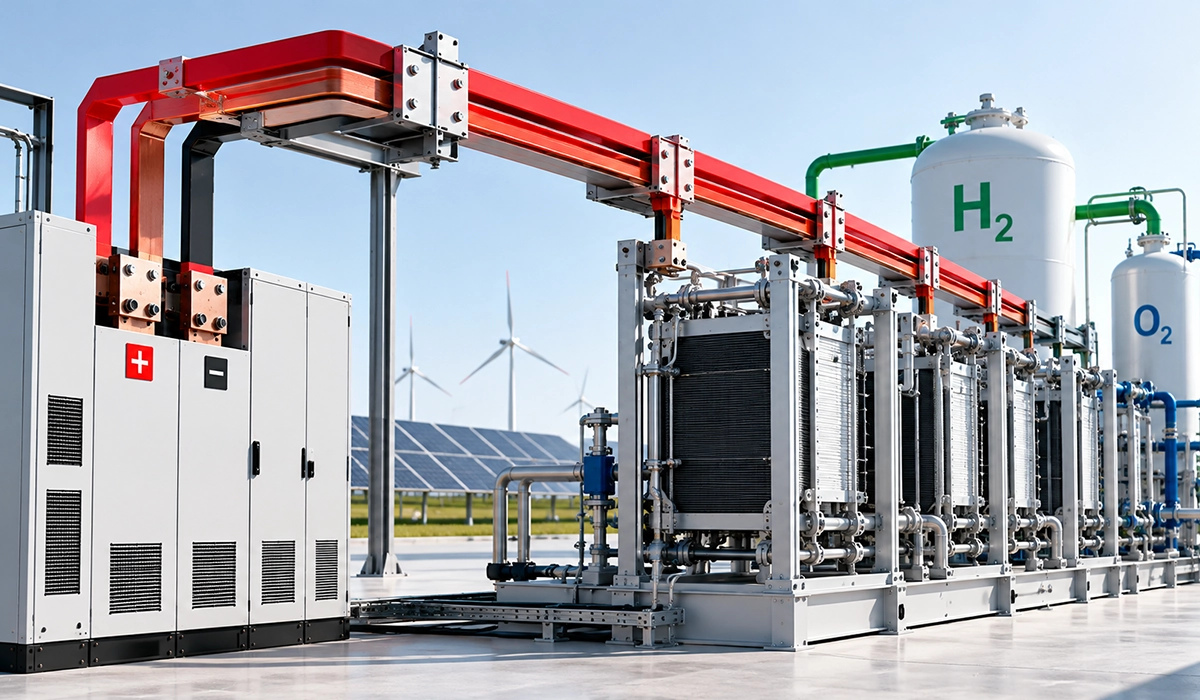
Green hydrogen electrolyzers split water with direct current, so the plant must turn AC grid power or variable solar output into a large, stable DC supply. A PEM electrolyzer power supply and an alkaline electrolyzer power supply share this goal, although PEM vs alkaline stacks differ in current density and dynamic response.
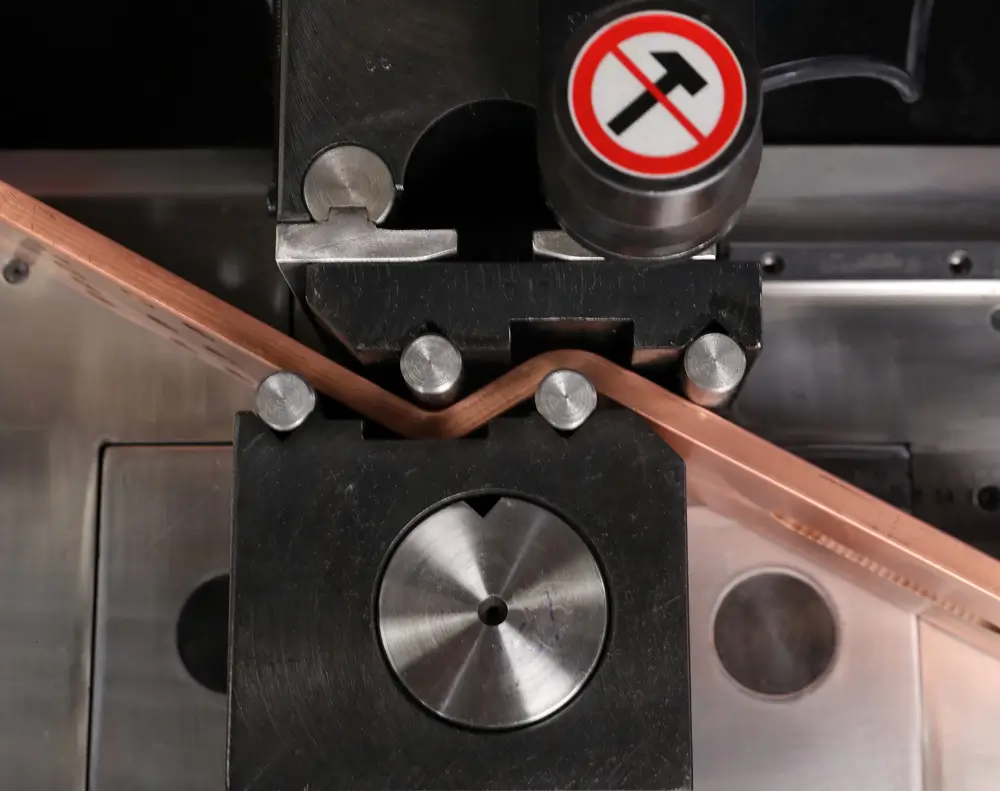
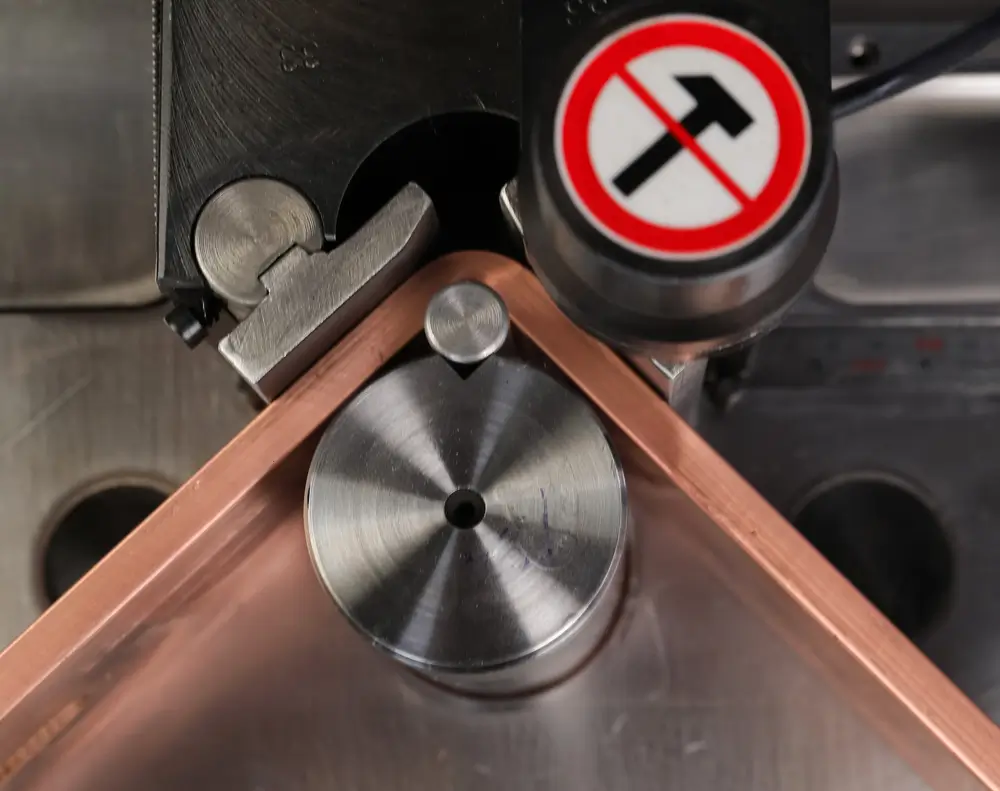
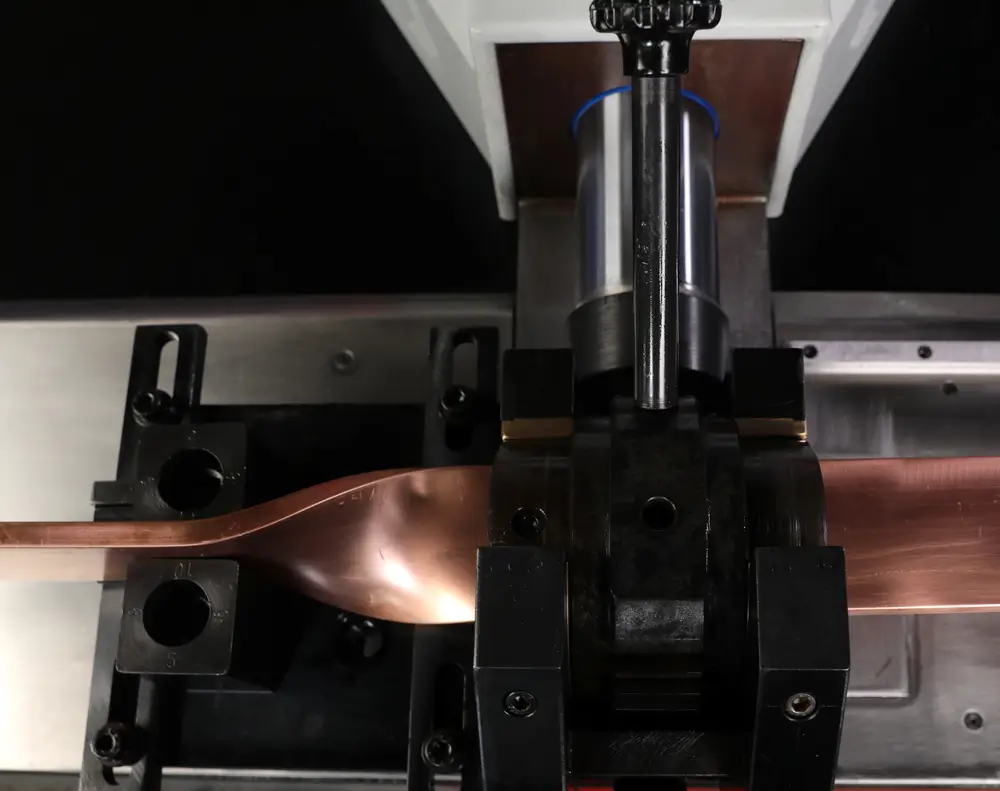
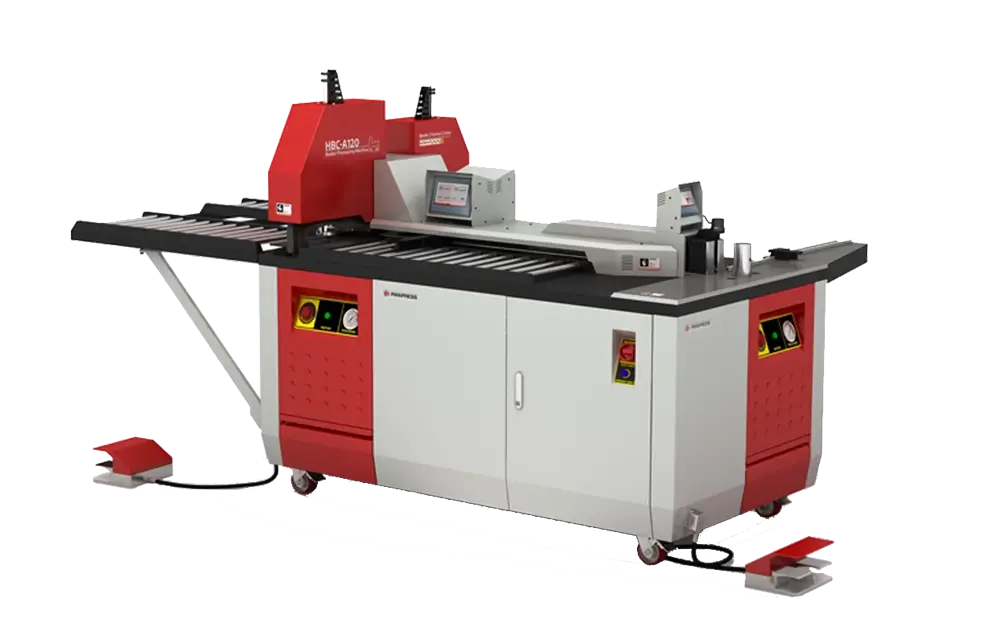
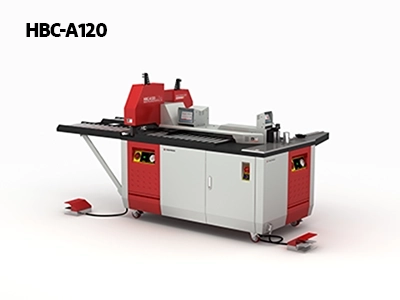
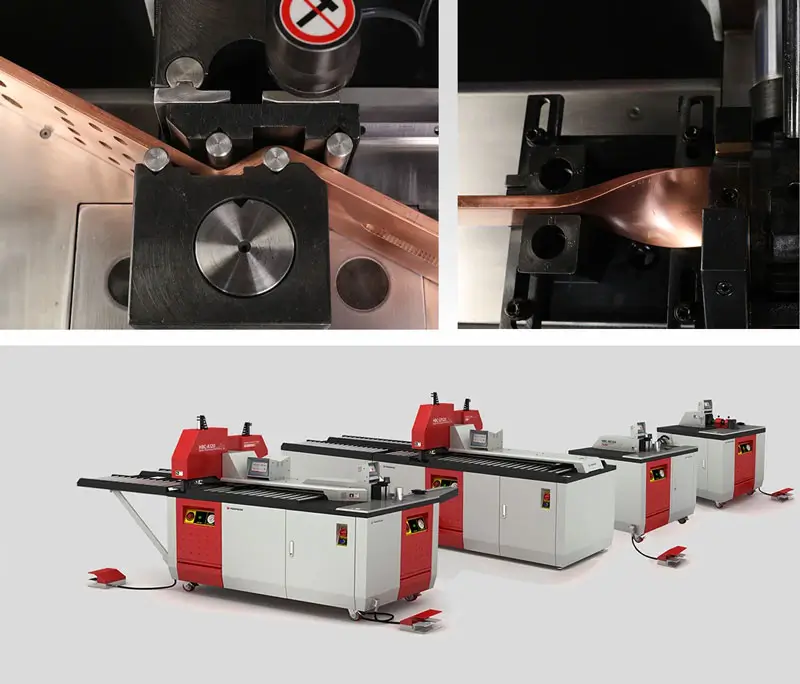
The PAYAPRESS HBC-A120ES combines cutting, punching, and bending operations for copper and aluminum busbars up to 120 × 12 mm. With its programmable positioning system, it delivers precise and efficient busbar fabrication for electrical switchgear and panel manufacturing.
From Grid or PV to Stack: The Power Chain
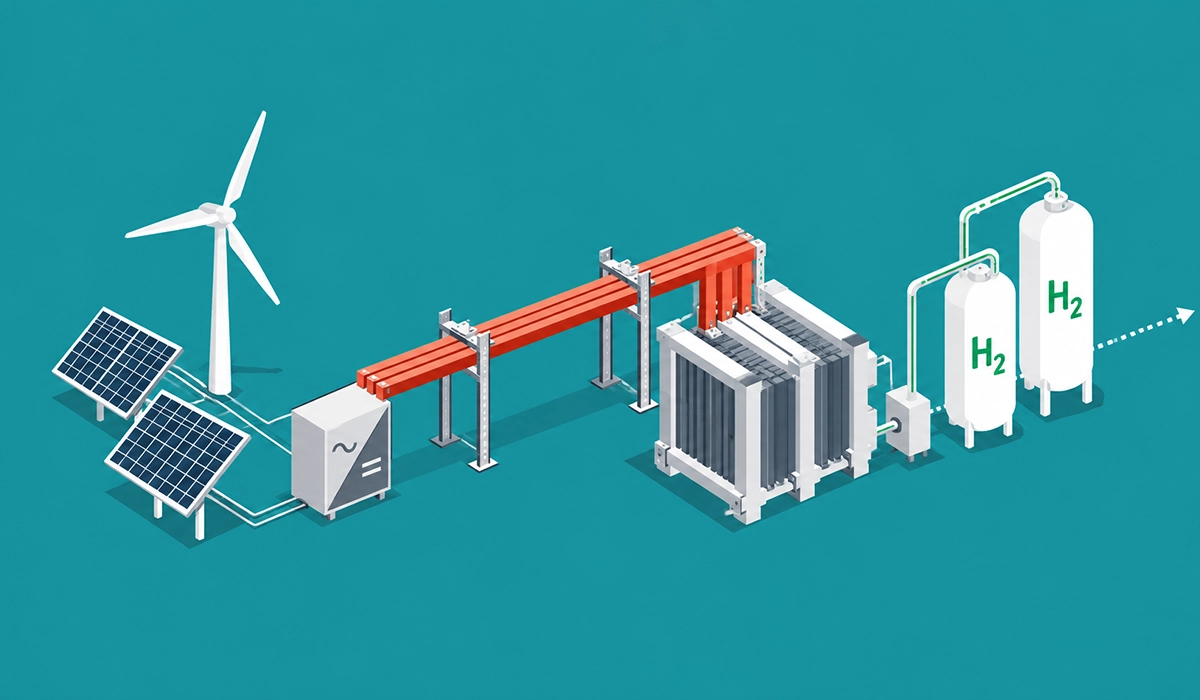
So, how is power delivered to an electrolyzer stack? First, a transformer adapts the grid voltage. Next, a rectifier converts AC to DC, while PV-coupled plants may use a DC/DC converter instead. Finally, the DC bus carries current to each electrolysis stack and its anode/cathode terminals.
Grid or PV → transformer → rectifier or DC/DC converter → DC busbar → stacks
Older plants often rely on thyristor rectifiers. However, Fraunhofer IEE reports that transistor technologies are replacing them, with silicon carbide prototypes built at about 200 kW and 2 MW. Similarly, a DigiKey article featuring Infineon devices looks at how designers choose thyristor, IGBT or MOSFET stages for stable DC. Ripple and harmonics remain a key trade-off, because they affect grid quality upstream and stack losses downstream.
Busbars sit at the heart of every high-power distribution path, not only in hydrogen plants. For a wider view of their types, design and applications, see our guide to electrical busbar systems.
Why Busbars Instead of Cables
At thousands of amperes, a cable route needs many parallel conductors, and each one adds two lugs. In contrast, a high current DC busbar uses a few large bars, so the route takes less space and has far fewer joints. Flat bars also expose more surface to air, which helps them shed heat. However, busbars need rigid supports and expansion links, while cables simply flex around obstacles.
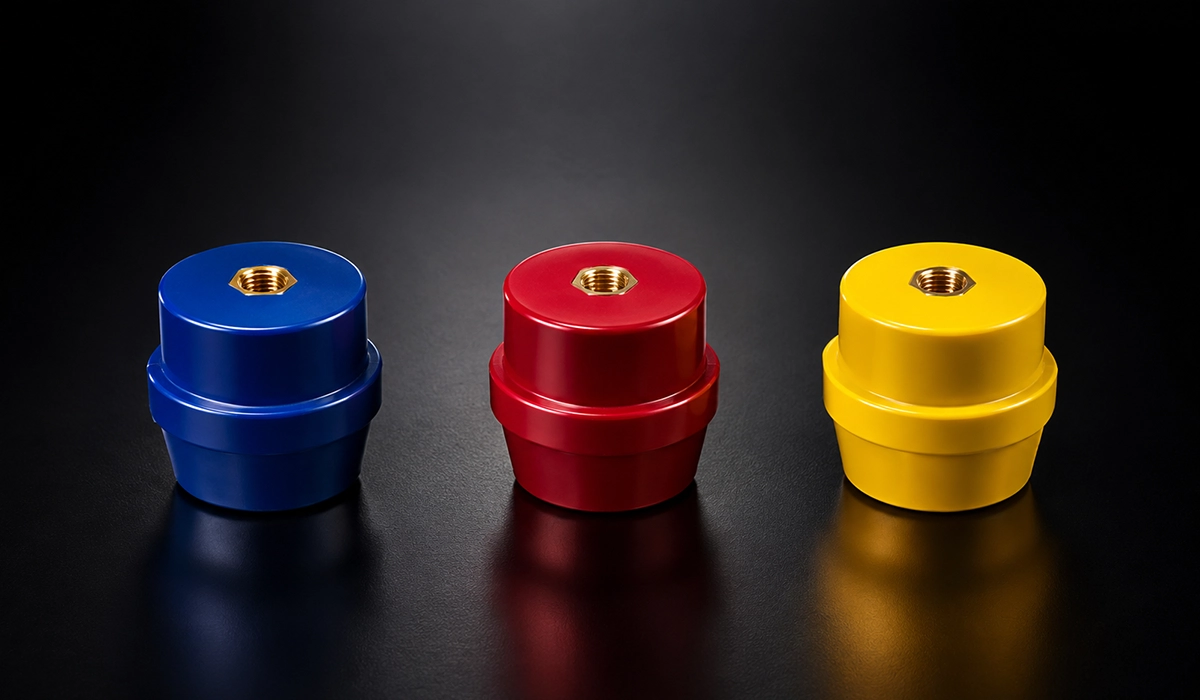
Inside the converter, a laminated busbar stacks thin conductor layers with insulation between them to cut inductance. A complete DC busbar system therefore combines rigid runs, flexible links and isolators.
Sizing a DC Busbar for an Electrolyzer
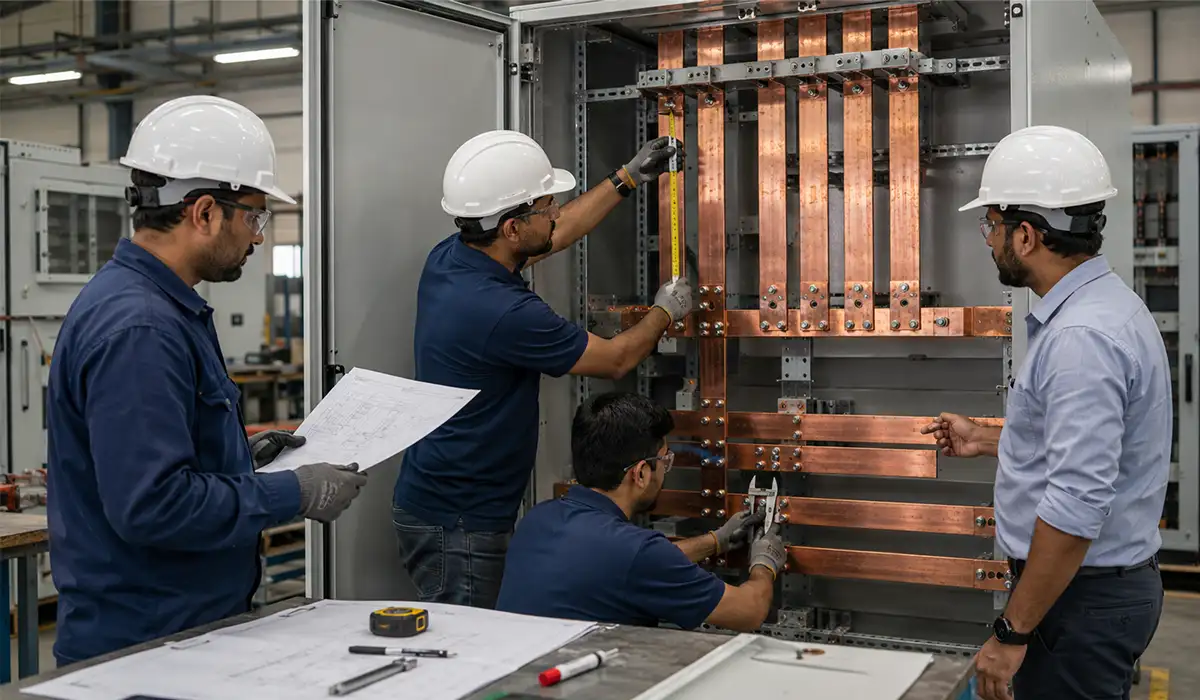
Electrolyzer DC busbar sizing balances current, losses, heat and cost. Here is how to size a busbar for an electrolyzer in five steps:
- Start from the maximum continuous stack current, plus a margin for overload operation.
- Choose a design current density that suits the conductor and the cooling method.
- Calculate the cross-section, then pick standard bar sizes.
- Check voltage drop and power loss over the full go-and-return length.
- Verify temperature rise, short-circuit forces and joint layout.
Worked example (hypothetical estimate): a 10 kA stack at 1.6 A/mm² needs about 6,250 mm² of copper, such as five 10 × 125 mm bars. Over a 30 m loop at about 70 °C, that gives roughly 1 V of drop and 10 kW of heat, before joint losses.
The Copper Development Association advises designing for a 30 °C rise or less for energy efficiency. Its guide also explains why DC ratings can differ from AC values in its copper ampacity tables.
The same ampacity logic also applies to AC panels and switchboards, with a few extra checks. Our step-by-step busbar sizing guide walks through those calculations in more detail.
Current Density and Ampacity
Current density is the current per unit of cross-section, usually given in A/mm². Ampacity is the current a bar can carry continuously without exceeding its allowed temperature rise. A higher density means less copper and lower capital cost, but it raises resistance losses and heat. In contrast, a lower density costs more metal, yet it cuts losses for the whole life of the plant. In DC, current spreads across the full section because there is no skin effect; however, rectifier ripple adds small AC components. Therefore, check ampacity tables first, then confirm the result with a thermal calculation or test.
Voltage Drop and Energy Loss
So, how do you reduce voltage drop in a DC busbar? First, increase the cross-section or shorten the route by placing rectifiers close to the stacks. Next, keep joints few, flat and tight, because each one adds resistance. Voltage drop on the stack side wastes energy directly: the rectifier supplies that loss, and the bus turns it into heat. Since electrolyzers often run for most hours of the year, even a small drop becomes a real operating cost. Lower losses also leave less heat for the cooling system to remove. In addition, a large drop eats into the rectifier’s voltage headroom as stacks age.
Temperature Rise and Cooling
Temperature rise drives both ampacity and joint life. Hot bars waste energy, and repeated heating and cooling loosens connections over time. Rectifier halls also run warm, so busbar cooling for electrolyzer rectifier rooms needs early attention. Natural convection works for moderate currents, especially with bars set edge-on and spaced apart. For very high currents, however, water cooling through hollow conductors removes heat in a compact space. That option adds pumps, hoses, leak detection and low-conductivity water, so it suits the densest sections. Finally, check that each rectifier busbar and stack terminal shares the same thermal limits.
Copper vs Aluminum vs Laminated: Choosing the Conductor
Conductor choice sets weight, cost, joint behavior and how easily the shop can bend the bars. The copper vs aluminum busbar decision covers most main runs, while a laminated busbar belongs inside the converter.
Copper keeps joints stable under heavy cycling, while aluminum saves weight and metal cost, so the trade-off needs test data. For example, a 2025 Copper Development Association test cycled both metals at 3,500 A and reports torque loss and joint resistance in its accelerated aging report.
Conductor metal is only half the story, because surface finish also shapes contact resistance. Learn when a silver plated busbar justifies its extra cost.
Material Comparison Table
The table compares the three options in qualitative terms, so check supplier data for exact values.
| Property | Copper | Aluminum | Laminated (in converter) |
|---|---|---|---|
| Conductivity | Highest of the common busbar metals | Lower; needs a larger section for the same current | Usually copper layers; high over short lengths |
| Weight | Heavy | Much lighter for the same resistance | Light, because runs stay short |
| Cost trend | Higher metal price, often volatile | Lower metal price; plating and hardware add cost | Highest per meter; custom tooling |
| Joint behavior | Stable; tolerates high clamp force | Oxide film, creep and expansion need extra care | Factory-made joints; few site joints |
| Bendability | Good; tight radii possible | Good, but needs larger radii | Formed during manufacture, not on site |
| Typical use | Main DC runs and terminations | Long runs where space allows | Inside rectifiers and DC/DC converters |
In short, copper wins where space, joint reliability and short-circuit strength matter most, while aluminum pays off on long, lightly packed runs.
Plating and Corrosion Protection
Plating protects contact faces from oxide and keeps joint resistance stable. For copper busbar plating for hydrogen plants, the usual choice is tin vs silver. So, what plating is best for high-current DC joints? Tin covers most cases: it costs less, resists general corrosion and suits standard bolted connections. However, it softens at high temperature and can suffer fretting under vibration.
Silver gives the lowest contact resistance and handles hotter joints, but it costs more and tarnishes where sulfur compounds are present. Humid halls, cooling-water leaks and caustic mist in alkaline plants all speed up corrosion. Therefore, match tin/silver plating to the site survey and plate both mating faces alike.
Joints, Bends and Terminations: Where Fabrication Matters
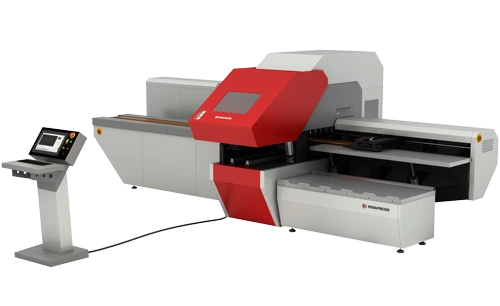
At PAYAPRESS, we build the machines that cut, punch and bend busbars, so we see the same faults on DC links again and again. In green hydrogen electrolyzers, most bus trouble starts at a joint or a badly formed bend, not in the straight bar.
Clamp force, surface finish and washer choice decide whether a bolted joint stays cool through repeated heating cycles. For example, an Auburn University study tested 60 bolted joint combinations and reports which factors mattered most in its bolted contact study.
Bend allowance and flat length decide whether holes still line up after forming. You can work out these values with our guide to copper busbar bending.
Joint Resistance and Torque
At 10 kA, one extra micro-ohm in a joint turns into 100 W of heat, so the busbar joint resistance high current DC circuits can tolerate is very small. First, contact faces must be flat, because bowed or burred bars touch only at a few points. Next, prepare the surface: abrade the oxide, clean it and apply contact compound just before assembly. Then check hole quality, since raised burrs or oval holes shrink the true contact area. Finally, tighten each bolted joint to the specified torque and use disc spring washers to hold clamp force through thermal cycles. Torque values depend on thread condition, as our lubricated vs dry bolt torque guide explains.
Cutting, Punching and Bending Thick Bars
Thick bars expose every weakness in tooling, and busbar bending tolerance for DC links decides whether parts bolt up cleanly on site. Cutting comes first. A shear with worn blades leaves a rolled edge and a burr, so we deburr every face that will touch another bar. For punching, our shop rule is simple: the hole diameter should not be smaller than the bar thickness. Below that, drilling is the safer choice.
Bending is where errors stack up. Each bend springs back slightly after the tool releases, so we measure the angle after release, not at full stroke. A copper busbar typically needs an inside radius at least equal to its thickness, while aluminum needs more. Also, holes placed too close to a bend stretch into ovals, so keep them clear of the bend zone or punch them afterward.
On a long DC link with three or four bends, small angle errors add up to millimeters at the far joint. As a result, installers force bars together, and the joint ends up stressed and hot. Therefore, set length, hole position and angle tolerances on the drawing, tighter than general ISO 2768 classes where joints mate.
Protection, Isolation and Standards
DC behaves differently from AC when something goes wrong. Because direct current has no natural zero crossing, an arc does not self-extinguish, so isolation and breaking devices need genuine DC ratings.
Electrolyzer systems also carry their own safety rules on top of electrical standards. The ISO catalogue entry for the 2025 safety part, which replaced the 2019 edition, sets out its scope on the ISO 22734-1 entry.
Fault currents also stress bars and supports mechanically before any protective device trips. Our article on short-circuit withstand explains how to check them against peak forces.
DC Isolation and Fault Protection
Most plants use two device types. A DC isolator gives a visible, off-load break, so workers can lock out a stack or bus section safely. A DC breaker, by contrast, interrupts current under load or fault. For example, MSS International describes its DC isolators as off-load devices with a visible isolation gap for maintenance (manufacturer information). Sécheron notes that a DC circuit breaker is not mandatory in every electrolysis layout, yet it can add real value (manufacturer information). In practice, the protection study decides the mix. Rectifier fault limiting, stack fault current and residual stack voltage after shutdown all shape the final choice.
Relevant Standards
The standards below often apply, but check the project specification, because listing a standard does not prove compliance.
- IEC 61439-1 and IEC 61439-2: general rules and power assemblies for low-voltage switchgear, up to 1,500 V DC.
- IEC 61439-6: busbar trunking systems, a useful reference for prefabricated bus runs.
- IEC 60865-1: calculating the mechanical and thermal effects of short-circuit currents on bars and supports.
- IEC 60146-1-1: basic requirements for semiconductor converters on the rectifier side.
- ISO 22734-1:2025: safety of hydrogen generators using water electrolysis.
- EN 13601: copper rod, bar and wire for general electrical purposes, a common material specification.
DC Busbar Design Checklist
Use this checklist for DC busbar design for hydrogen electrolyzer projects before you release drawings.
| Check | What to confirm |
|---|---|
| Design current | Maximum continuous stack current plus overload margin |
| Current density | Value suits the conductor and cooling method |
| Voltage drop | Go-and-return drop and loss stay within budget |
| Temperature rise | Within conductor, insulation and terminal limits |
| Short-circuit | Bars and supports withstand peak forces |
| Conductor | Copper or aluminum choice justified |
| Plating | Tin or silver matched to the site atmosphere |
| Joints | Flatness, surface prep, torque and disc springs specified |
| Fabrication | Bend radii, hole positions and angle tolerances on drawings |
| Isolation | Isolators and breakers rated for DC duty |
Many of these checks mirror the design verification that low-voltage assemblies already require. The IEC catalogue entry lists general rules, construction requirements and verification routes in its IEC 61439-1 summary.
Many engineering teams now run these checks in dedicated tools rather than spreadsheets. Compare the main options in our review of busbar design software.
Conclusion: Green Hydrogen Electrolyzers
The busbar rarely gets attention, yet it decides how much rectifier output actually reaches the stacks. Size it for current density, voltage drop and temperature rise. Then choose copper or aluminum with joints in mind, and treat fabrication tolerances as part of the electrical design. Done well, the bus stays cool, efficient and easy to maintain, and it protects the output of green hydrogen electrolyzers for their whole service life.
As electrolyzer plants scale up, busbar technology keeps evolving alongside them. Explore the future busbar trends shaping modern power distribution.


Rate this article
Choose a rating from 1 to 5 stars.
No ratings yet