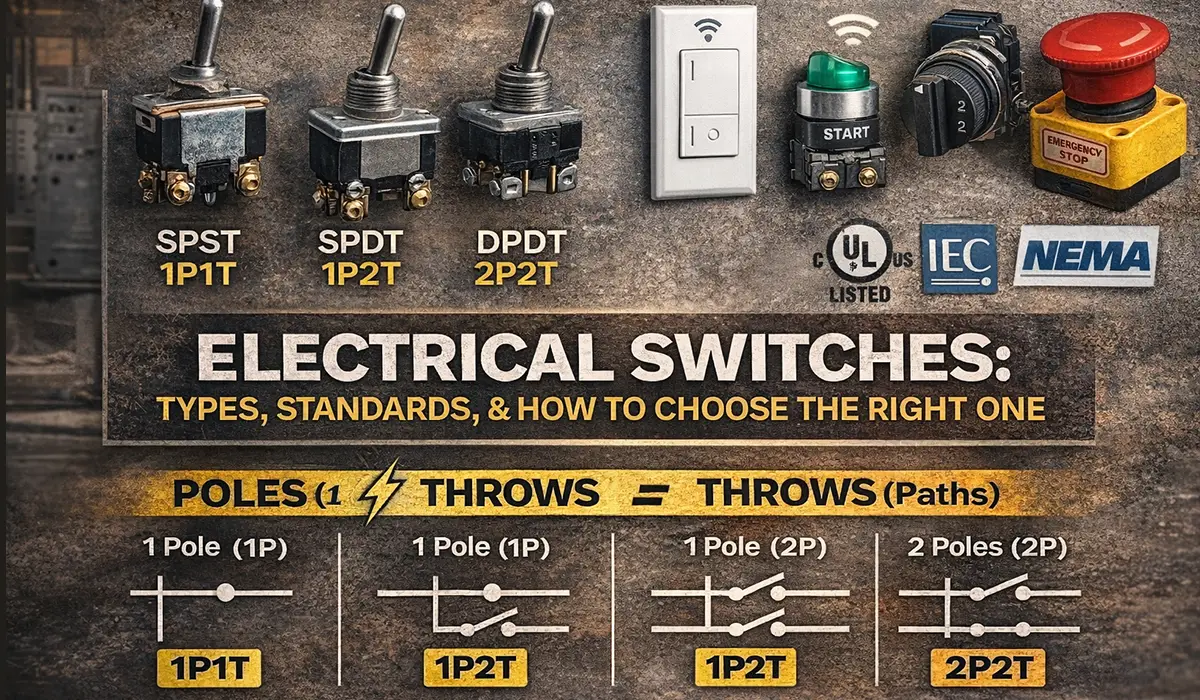
Electrical switches are more than just simple devices; they play a pivotal role in ensuring safety, efficiency, and compliance in any electrical system. Choosing the wrong switch can lead to nuisance failures, overheated contacts, or failure to meet regulatory standards, potentially causing significant issues. On the other hand, selecting the right switch ensures years of reliable operation with minimal maintenance. This guide delves into the fundamentals of electrical switches, explaining key terms such as poles and throws, the types of switches, and the standards that apply to industrial settings like switchgear assemblies and control panels. Whether you’re selecting a switch for residential use, industrial control systems, or smart home applications, this guide will help you understand the critical factors to make the best choice.
Electrical Switches: Types, Standards, and How to Choose the Right One
Electrical switches may look simple at a glance, but they sit at the intersection of safety, usability, and compliance. Pick the wrong one and you might get nuisance failures, overheated contacts, or a panel that cannot pass inspection. Pick the right one and everything just works quietly for years — which is the dream.
This guide explains what an electrical switch is, how poles and throws shape behavior (SPST vs SPDT, DPDT, 3-way, 4-way), where smart switches fit, and which standards matter for industrial applications like switchgear assemblies and industrial control panels.
For a comprehensive understanding of electrical panel types used in these systems, we highly recommend reviewing this electrical panels guide.
What Is an Electrical Switch? (Definition & Fundamentals)
An electrical switch is an electromechanical device that controls current flow by changing circuit continuity. In the open (OFF) position, the circuit path is interrupted; in the closed (ON) position, current can flow.
Most switches include an actuator (what the user presses, flips, or turns), contacts (the conductive parts that make/break the circuit), terminals (where conductors connect), and a housing to protect and align everything. Two terms show up everywhere: pole and throw. They define how many circuits are controlled and how many output paths exist, which is why they matter more than the shape of the toggle or rocker.
This article serves as a valuable resource for those seeking detailed information on industrial electrical panel components including switches and their role in the overall assembly.
Poles and Throws Explained (SPST, SPDT, DPDT)
Poles = how many circuits you control. Throws = how many output paths/positions you can select. SPST is simple ON/OFF; SPDT selects between two outputs; DPDT is two SPDTs operated together.
| Description | Switch Type |
|---|---|
| Single Pole Single Throw — simple ON/OFF, one circuit, one path | SPST |
| Single Pole Double Throw — one circuit, selects between two output paths (changeover) | SPDT |
| Double Pole Single Throw — two circuits controlled together, each with one path | DPST |
| Double Pole Double Throw — two SPDTs ganged together, two circuits each with two paths | DPDT |
| Controls one fixture from two locations — uses traveler wires between switch pairs | 3-Way |
| Inserted between two 3-way switches — adds additional control locations | 4-Way |
Types of Electrical Switches (By Operation & Use Case)
By mechanism, common families include toggle, rocker, pushbutton, rotary/selector, and slide switches. The physical interface affects ergonomics, accidental activation risk, and whether operation is maintained (stays in position) or momentary (returns when released).
By application, you will see lighting switches (wall control), limit switches (machine position feedback), selector switches (mode selection), and emergency stop devices (safety function). In industry, the “type” is often less important than the rating and duty the switch must survive.
By environment, the switch enclosure matters: dust, wash-down, oils, vibration, and outdoor exposure push you toward sealed designs and clear IP requirements. IP ratings are defined under IEC 60529.
Further exploration of switchgear types and their role in modern power distribution can be found in the following recommended reading: evolution of modern switchgear.
Residential Lighting Switches
Residential switching commonly includes single-pole, double-pole, 3-way, and 4-way switching, plus dimmers, timers, and occupancy sensors. Multi-way switching (3-way/4-way) is about control from multiple locations, not “more power.”
If you are looking for more information about arc fault breakers used alongside residential switches, it is recommended not to miss reading this arc fault breakers guide.
Industrial & Panel-Level Switches
Industrial panels use pushbuttons, selector switches, and limit/position switches for control and signaling, with attention to contact rating, expected cycles, and the load type (pilot duty vs power switching). IEC 60947-5-1 explicitly covers many of these control-circuit devices.
Smart Light Switches (When and Why to Use Them)
A smart light switch adds electronics and communications (often Wi-Fi, Zigbee, Z-Wave, Thread) so the switch can be controlled by apps, schedules, scenes, or voice assistants. The advantage is keeping normal wall control while gaining the convenience of automation.
The wiring detail that trips people up: many smart switches need continuous power, which is why a neutral wire is often required. Some products are designed for no-neutral installations, but they may need specific load conditions or a bypass/adapter depending on the design.
Use a smart switch vs smart bulb based on what you want to control: switches are better for whole circuits and consistent wall behavior; bulbs are better for color scenes and per-lamp control when the wall switch stays ON.
Further exploration of which wire is suitable for these installations can be found in the following recommended reading: wire selection for industrial electricity.
Ecosystem & Standards Snapshot
The ecosystem is converging around Matter, with Thread and Wi-Fi as common transports, aiming to improve cross-platform compatibility. More Matter-supported wall controls, keypads, and dimmers are being designed to behave like “normal” switches while still automating well.
Standards & Compliance for Industrial Applications
For industrial use, think in layers. IEC 60947 covers low-voltage switchgear and controlgear components including many control devices. IEC 61439 sets requirements and verification for low-voltage switchgear and controlgear assemblies — the complete assembly, not just a single switch. UL 508A is the key standard for industrial control panels in the UL ecosystem.
If you set out to look for contact ratings in industrial control circuits, you will also run into utilization categories (for example AC-15 and DC-13) used to describe duty types for control-circuit switching and loads. For a comprehensive understanding of optimizing switchgear performance.
This article serves as a valuable resource for those seeking detailed information on switchgear fundamentals underpinning these compliance layers.
Selecting to a Standard (IEC vs. UL Considerations)
Choose switches certified or recognized for the target market, then design labeling, documentation, and verification around the system standard — IEC assembly verification vs UL panel construction approach. UL 508A updates and summaries are practical starting points for teams supporting North American control panels.
If you are looking for more information about industrial electrical switchboards where these standards converge, it is recommended not to miss reading this industrial electrical switchboards guide.
Selection Criteria: How to Choose the Right Electrical Switch
Start with the electrical problems: voltage, current, and the load type (resistive, inductive, pilot duty, DC vs AC). A switch’s contact rating is only meaningful in context — load characteristics and duty cycle drive heating, arcing, and wear.
Next, validate performance: breaking capacity, expected electrical life vs mechanical life, and whether you need momentary vs maintained action. Contact life is application-dependent, and switching near rating will shorten life faster than light duty. Then, match the environment and safety: IP rating (or NEMA where applicable), sealing against dust/water jets, ergonomics, lockout/guarding, and any required interlocks.
Further exploration of circuit breaker finders and selection tools can be found in the following recommended reading: circuit breaker finder guide.
Application Scenarios & Quick Picks
Choose by scenario: stairwell lighting needs multi-location control; wash-down needs sealing; conveyors need clear START/STOP; global projects need components aligned to the destination standard set. If you are looking for more information about emergency electrical panels where switch reliability is most critical, it is recommended not to miss reading this emergency electrical panels guide.
Wiring Basics & Safety (For Reference Only)
Wiring is where “simple” turns into “surprise, it’s live.” Conceptually, switching usually interrupts the hot conductor to control the load. Single-pole and multi-way circuits use different terminal conventions, and smart switches may require neutral or a specific installation method.
For safety: de-energize, verify absence of voltage, label breakers, and use a licensed electrician for anything beyond basic replacement in an appropriate jurisdiction. The goal here is understanding, not DIY instructions. For a comprehensive understanding of underground electrical conduit used to protect wiring in these systems.
Switch-Legs & Multi-Way Control
A switch leg is a switched hot run to a fixture, and multi-way control uses traveler wires between switches to create alternate hot paths. The table below summarizes the key wiring terms.
| Function & Direction of Flow | Term |
|---|---|
| Supplies constant power from the panel — flows Panel → Switch | Line (Hot) |
| Carries power to the light only when the switch is ON — flows Switch → Light | Load (Switch Leg) |
| Connects two switches in a multi-way system — flows Switch ↔ Switch | Traveler |
| The return path for current to complete the circuit — flows Light → Panel | Neutral |
Commercial Safety Warning
CRITICAL WARNING: Never attempt DIY work on commercial electrical panels. Unlike residential wiring, commercial systems often use dangerous high voltages (277/480V) with massive amperage, posing fatal arc flash risks. Compliance with strict NEC codes is mandatory; unlicensed work creates severe legal liability and voids insurance. For any commercial or industrial electrical issues, you must hire a licensed, insured master electrician.
Switch Leg (The Loop)
A “Switch Leg” (or loop) wiring configuration occurs when power enters the light fixture first rather than the switch box. A “hot” wire brings power down to the switch, and a “switched leg” returns it to the light. This loop extends the circuit to the wall, allowing the switch to break the connection and control the fixture.
Traveler Wires (Multi-Way)
Multi-way switching — controlling lights from two locations — relies on “Traveler” wires. These two wires connect only the switches, running parallel like dual train tracks. Flipping either switch selects a different “track,” allowing you to complete or break the circuit instantly from either location.
This article serves as a valuable resource for those seeking detailed information on busbar systems inside power switchboards, where similar concepts of parallel current paths apply at the distribution level.
Maintenance, Reliability & Safety
Reliability is mostly boring discipline: inspect for heat discoloration, loose terminations, cracked housings, contamination ingress, and signs of arcing. Torque checks and periodic inspection are common maintenance recommendations in motor control and panel literature. If you are looking for more information about harmonic filters that reduce stress on switch contacts and panel components, it is recommended not to miss reading this harmonic filter guide.
In energized industrial environments, arc flash risk is real. Mitigation strategies include design and settings choices that reduce incident energy, plus maintenance-oriented approaches like energy-reducing methods and operational practices aligned with NFPA 70E principles. For a comprehensive understanding of Rittal electrical panels and enclosures that protect these switches in harsh environments, we highly recommend reviewing this Rittal electrical panels guide.
When in doubt, prioritize: correct ratings, correct environment protection, and correct compliance pathway. A cheap switch that fails early is not “cost-effective” — it is just expensive later.
Conclusion
In conclusion, electrical switches are integral to the functioning of both residential and industrial electrical systems. Whether you’re dealing with simple SPST switches or more complex DPDT or smart switches, the key to choosing the right one lies in understanding the application’s needs, the environmental conditions, and the relevant standards. By considering factors like voltage, current ratings, and the required durability, you can ensure that the switch you choose will provide reliable performance while meeting safety and regulatory requirements. Proper selection and installation are vital, as they ensure that your electrical systems remain efficient, safe, and compliant for years to come.
FAQs
How does an electrical switch work?
A switch works by mechanically opening or closing contacts to interrupt or complete a circuit, controlling whether current can flow to the load.
What’s the difference between single-pole and double-pole switches?
Single-pole typically controls one circuit from one location. Double-pole controls two conductors/circuits together, often used where disconnecting both hots is required for certain loads.
SPST vs SPDT — when should I use each?
Use SPST for simple ON/OFF control. Use SPDT when you need to select between two outputs or two paths (changeover behavior).
What is a 3-way or 4-way switch?
A 3-way switch pair controls one light from two locations using travelers. A 4-way switch is inserted between two 3-way switches to add additional control locations.
Do I need a neutral for a smart switch?
Many smart switches require neutral for continuous power, but some products are designed for no-neutral installations. Always match the device requirements to the wiring and load conditions.
Which standards apply to switches in industrial control panels?
Switch selection is influenced by IEC 60947 for control devices and components and IEC 61439 for assemblies, while UL 508A is central for industrial control panel construction in UL-based compliance. If you are looking for more information about capacitor switchboards where switch ratings and coordination are especially critical.