


For your convenience, if you prefer listening, you can listen to the rest of this article via the audio file below.
Project Snapshot
Before I get into the journey, here is the project context that shaped every decision.
| Item | My Actual Situation |
|---|---|
| Facility type | Small light-industrial workshop + office |
| Goal | Reliable power distribution + room for expansion |
| Voltage level | Low voltage distribution |
| Priority | Safety, uptime, serviceability, future expansion |
| Constraint | Budget + lead time + local inspection schedule |
| Biggest mistake | Treating panelboards, switchboards, and switchgear as interchangeable |
How I Finally Framed the Project
At the beginning, I was asking the wrong question.
I kept asking vendors, “What is the best electrical panel for my building?” That sounds normal, but it is too vague. In practice, it can mean a load center, a panelboard, a switchboard, a switchgear lineup, or even an industrial control panel.
The breakthrough came when I stopped thinking in product names and started thinking in job roles inside the power system.
I wrote this on a whiteboard:
- Where does power enter?
- Where is it distributed?
- Where is heavy-duty protection needed?
- Where are machine controls handled?
That simple framing changed everything.
UL itself separates these categories in its low-voltage distribution ecosystem and assembler programs, listing panelboards (UL 67), switchboards (UL 891), switchgear (UL 1558), and MCCs (UL 845) as distinct assembly categories.
The moment I realized “panel” was too generic
I had requested a quote for what I called a “main panel.” The distributor came back with a compact panelboard option.
On paper, it looked fine.
But when we reviewed my expansion plan (future feeders, metering, spare sections, easier maintenance access), it became clear I was really describing a switchboard, not just a panelboard.
That was my first practical lesson:
A generic “electrical panel” is a conversational term. In procurement, I need to specify the exact assembly type.
If you are looking for more information about power distribution boards, it is recommended not to miss reading this article.
Panelboard vs Switchboard vs Switchgear: The Differences That Actually Decided My Project
When I finally sat down and put the three side by side, the decision took about ten minutes. Here is the table I wish someone had handed me on day one.
| Panelboard | Switchboard | LV Switchgear | |
|---|---|---|---|
| US Standard | UL 67 | UL 891 | UL 1558 (with IEEE C37.20.1 / ANSI C37.51) |
| How It Mounts | Wall-mounted — flush or surface | Free-standing on the floor | Free-standing on the floor |
| Access | Front only | Front only, or front and rear | Front and rear |
| Typical Main Rating | Up to approximately 1,200 A | Approximately 1,200–6,000 A bus rating | Generally used for the highest-duty applications |
| Protective Devices | Moulded-case circuit breakers, bolt-on or plug-in | MCCBs, ICCBs, or fusible switches, up to approximately 5,000 A | Draw-out low-voltage power circuit breakers |
| Delivered As | Trim, back box, and interior, assembled on site | Fully assembled sections | Fully assembled sections |
| What It Is For | Branch-circuit distribution | Main LV distribution, feeders, service entrance, and metering | Higher fault duty, advanced protection, and maintenance while energised |
Ratings are typical industry figures, not code limits. Confirm against the manufacturer’s data and your AHJ before you specify anything.
The row that decided my project was access. A panelboard is front-only, and I already knew I would be adding feeders later. Once I pictured myself working in a live electrical room with no rear access, the switchboard paid for itself before it was even ordered.
The row that stopped me overspending was the protective devices row. Switchgear uses draw-out low-voltage power circuit breakers, and that is a genuinely different class of equipment — it exists so you can maintain a breaker without shutting the section down. I did not need that. I was never going to have a maintenance crew working on a live bus in a two-person workshop.
You can download the Marking and Application Guide Panelboards here.
Is a distribution board the same as a panelboard?
This one confused me for a week, and it turned out to be a language problem, not an engineering one.
“Panelboard” is the US term. It is what UL 67 covers and what the NEC uses. “Distribution board” is the term used almost everywhere else — the UK, the EU, the Middle East, India, Australia — and it sits under IEC 61439-3 rather than UL 67.
Functionally they do the same job: take one incoming supply and split it into protected branch circuits. So if a supplier’s datasheet says “distribution board” and your specification says “panelboard,” you are probably talking about the same piece of equipment. What is not the same is the certification path. A distribution board built and verified to IEC 61439-3 is not a UL 67 listed panelboard, and swapping the words in a specification does not swap the listing.
That distinction cost me part of a day on the phone. If you are buying in the US, ask for the UL listing, not the product name.
And what about a load center?
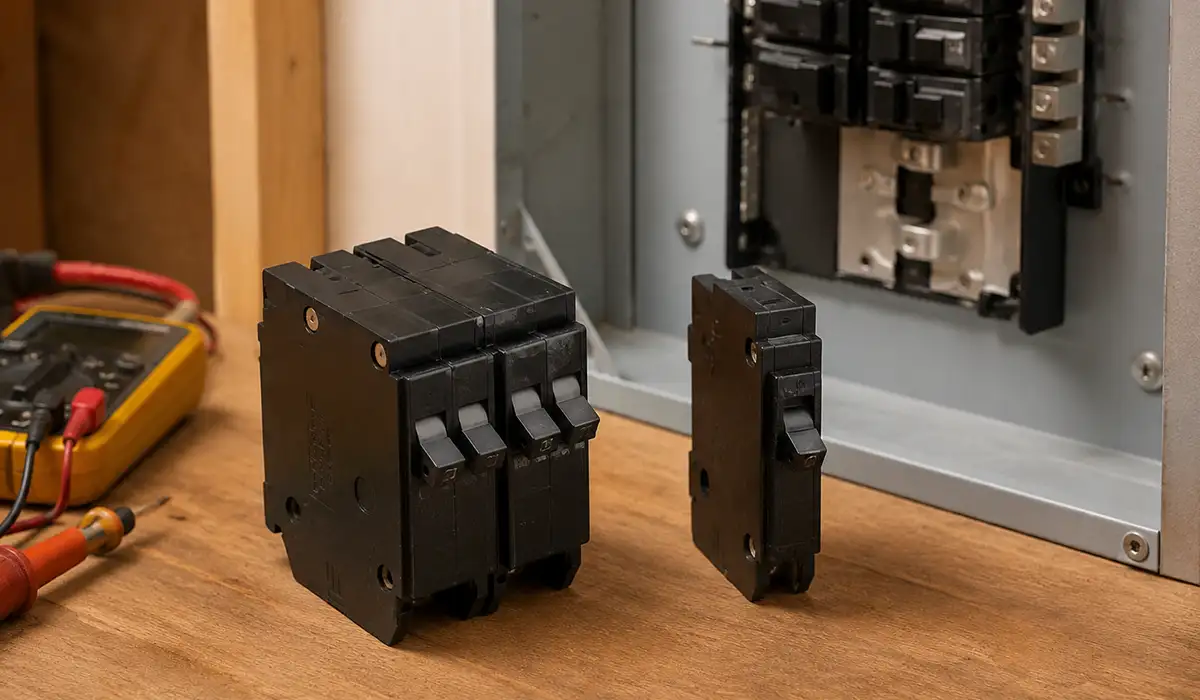
A load center is a panelboard. As far as UL and the NEC are concerned there is no difference between the two — in North America the industry simply calls the smaller, lower-cost panelboards sold mainly into residential work “load centers.” The practical differences are that panelboards are usually deeper and accept both bolt-on and plug-in breakers, while load centers take plug-in breakers only and are limited to 240 V or less, typically at 100 A and no more than 400 A
If someone quotes you a load center for a light-industrial workshop, that is the signal to go back and re-scope.
What I now mean by “electrical panel”
In everyday conversation, I use “electrical panel” as a broad term for an enclosure or assembly that controls and distributes power.
In formal US product/compliance language, that broad term splits into more specific categories.
For example, UL 67 covers panelboards and explicitly states they are intended for the primary function of control and protection of electrical circuits, and it points separately to UL 508A for industrial control panel assemblies.
You can download Control panel design guide according UL 508A here.
If the information related to busbars in panels was interesting and informative to you, researching electrical panel standards can be very engaging.
When a Switchboard Is the Right Choice Over a Panelboard
For my project, a switchboard became the right choice for the main distribution role because I needed:
- Higher ampacity options
- Multiple feeders
- Metering
- Service entrance flexibility
- Future modifications without replacing the whole system
UL 891 is the key standard family for switchboards in North America, and UL Solutions describes it as the most common switchboard standard in the region.
Since busbars play a crucial role in the production of electrical panels, obtaining more information about electrical busbars can be very important and essential.
Industrial Switchgear vs Panelboard: When the Extra Cost Is Justified
I almost overbought switchgear because I liked the idea of “industrial grade everything.”
Then I learned a painful truth: “more robust” is not always “better value.”
UL 1558 covers metal-enclosed low-voltage power circuit breaker switchgear and is used with IEEE C37.20.1 and ANSI C37.51. That is a different class of assembly than a standard UL 891 switchboard.
Eaton’s comparison page was helpful because it clearly distinguishes UL 1558 switchgear from UL 891 switchboards and highlights that UL 1558 includes more specific requirements and test expectations.
You can review the original source here to verify the technical details.
How electrical switchgear works in plain English
This is the explanation I wish I had on day one:
Switchgear is not just a “big cabinet with breakers.”
It is a coordinated assembly designed to interrupt faults safely, isolate sections, protect equipment, and support maintenance/service operations at a higher duty level. In many cases, it includes more advanced protection, compartmentation, and operational features than a typical distribution switchboard.
That understanding kept me from using switchgear where a switchboard was perfectly adequate.
My comparison cheat sheet
| Assembly | What I used it for in planning | Typical standard(s) I checked first | My selection trigger |
|---|---|---|---|
| Panelboard | Branch circuit distribution | UL 67, NEC/NFPA 70 | Smaller distribution areas, simpler layout |
| Switchboard | Main LV distribution and feeder coordination | UL 891, NEMA PB-2 / PB 2.1, NEC | More feeders, service entrance, metering, expansion |
| Switchgear | Heavier-duty, more advanced protection/service needs | UL 1558, IEEE C37.20.1, ANSI C37.51 | Higher fault duty, advanced protection, maintainability priorities |
| Industrial control panel | Machine/process control | UL 508A, NEC Article 409 context | Control logic, motors, automation, machine interfacing |
To explore the topic in greater depth, review the information available on this website.
You can also download UL 67 low-voltage distribution power panelboards.
Types of Power Distribution Assemblies: A Framework That Actually Helped
After the basics, I moved into architecture.
This was the stage where I almost drowned in internet lists like “4 types of electrical panels” and “3 types of control panels.” Some of those lists are useful. Many are repetitive or context-free.
So, I simplified the topic around function and layout, not random numbering.
The Practical Types Framework I Used
Instead of memorizing every internet list, I grouped my options into these practical categories:
- Service/distribution assemblies (panelboards, switchboards, switchgear)
- Control assemblies (UL 508A industrial control panels)
- Specialized assemblies (MCCs, transfer equipment, etc.)
This helped me eliminate repetitive titles and overlapping definitions in my notes.
The three control panel categories I used in real life
For my planning documents, I used three control-panel categories:
- Machine control panels (single machine or cell)
- Process control panels (multi-step processes, sensors, interlocks)
- Power/control integration panels (distribution + controls in the same project, but not always the same enclosure)
This was not a legal classification. It was a project management classification that kept me sane.
My TTA vs PTTA confusion and how I corrected it
This one caused a real delay.
I had an old supplier document that still used TTA and PTTA terminology. I started comparing assemblies with that language, and it created confusion with a newer spec package.
Then I rechecked IEC references and learned the newer IEC 61439 approach replaced the old TTA/PTTA framing with verified assembly concepts (design verification and routine verification structure). Schneider’s explanation of the IEC 61439 transition helped me clean this up.
That mattered because old terminology can make discussions messy, especially when one party uses legacy wording and another uses newer compliance language.
Architecture choices I did not appreciate at first
I originally focused too much on amps and breaker brands.
But layout details hit me later and hit hard:
- Front-only vs front-and-rear access
- Space for cable bending radius
- Future feeder additions
- Metering sections
- Utility metering provisions
- Serviceability without shutting down too much of the building
You can find more background information and related technical notes through this reference link.
When I started reading product documentation and application pages, I noticed how often manufacturers emphasize access, enclosure type, and modular expansion, not just amp ratings. Eaton’s UL 891 switchboard pages, for example, highlight ratings, enclosure types (NEMA 1 / 3R), access arrangements, and device mix options.
You can download Low Voltage Switchgear and IEC61439 document here.
US Standards for Panelboards, Switchboards and Switchgear
This was the part that saved my project from becoming expensive guesswork.
I stopped asking, “Which brand is best?” and started asking, “Which standard and assembly class matches my application?”
That is the right order.
The standards stack I checked first in the US
I built a short “must-check” list for every quote review:
- NFPA 70 (NEC) for installation/code compliance context
- UL 67 for panelboards
- UL 891 for switchboards
- UL 1558 for metal-enclosed LV power circuit breaker switchgear (with IEEE C37.20.1/ANSI C37.51 relationship)
- UL 508A for industrial control panels
- NEMA PB-2 / ANSI/NEMA PB 2.1 for switchboard product/handling guidance context
- NFPA 70E for workplace electrical safety and arc-flash risk management approach during operation/maintenance planning
I am not saying this replaces engineering design or AHJ review. It does not.
But this list stopped me from comparing apples to forklifts.
Further exploration of busbar selection for LV panels can be found in the following recommended reading.
Commercial vs industrial switchgear and switchboard choices: what changed in my thinking
My first assumption was simple and wrong:
Commercial = cheap equipment, industrial = expensive equipment.
The real difference is more about duty, protection philosophy, uptime expectations, maintenance approach, fault levels, and operational risk.
For a commercial building with moderate complexity, a well-specified UL 891 switchboard and panelboard system may be exactly right.
For a heavy industrial process area with higher fault duty, advanced protection schemes, or more demanding service needs, UL 1558 switchgear may be justified.
Eaton’s comparison and UL 1558 references helped me understand that the switchgear category is not just branding language. It is a distinct equipment class with its own test and performance framework.
How I compared safety features in modern switchgear systems
This is where I changed my budget allocation.
I initially cared only about breaker interrupting ratings and enclosure size.
Later, I started asking about safety and operational features such as:
- Arc-flash mitigation functionality
- Compartmentation
- Remote operation options
- Diagnostics and metering
- Communication capability
- Maintenance workflow safety
NFPA 70E exists because shock, electrocution, arc flash, and arc blast are real workplace hazards, not abstract training topics.
On the product side, manufacturers increasingly emphasize intelligence and safety functions. Eaton’s Pow-R-Line Xpert materials highlight communication, diagnostics, and enhanced safety through ARMS functionality in the product family ecosystem. Siemens also markets arc-mitigating low-voltage switchgear solutions focused on personnel protection during routine duties.
That made me shift from “lowest quote wins” to “lowest total operational pain wins.”
For the latest available details, check the official page directly.
Power Distribution Alternatives I Compared Before Deciding
Before I signed anything, I made myself list every route that could do the job without buying full switchgear. Four of them turned out to be genuinely viable, and one of them is what I chose.
A UL 891 switchboard with intelligent breakers and metering. This is the one I picked. Modern electronic trip units and integrated metering give you most of the diagnostic and arc-mitigation capability that pushed me toward switchgear in the first place, inside a switchboard that costs less and ships sooner. If the thing attracting you to switchgear is the intelligence rather than the draw-out breakers, this is usually the answer.
A compartmentalised switchboard. A middle ground. You get barriers between sections, so a fault or a maintenance task is contained, without moving to a full UL 1558 assembly. Worth quoting if your concern is service continuity rather than fault duty.
Distributed panelboards instead of one large assembly. Rather than one big board feeding everything, put smaller panelboards near the load zones. This reduced my feeder lengths and meant a fault or a shutdown in one zone did not take the whole shop down. It costs more in enclosures and less in copper.
Busway plus local panelboards. This becomes competitive when feeder runs get long or when you expect to move machines around. You run the busway once and tap off wherever you need power later, instead of pulling a new feeder every time the layout changes. In a fabrication shop that reconfigures, that flexibility is worth real money.
Separating the control panels out entirely. Keeping UL 508A industrial control panels physically and administratively separate from the power distribution assemblies made every compliance conversation shorter. Two clear scopes are easier to submit, easier to inspect and easier to modify than one hybrid cabinet.
The point of the exercise was not to find something clever. It was to stop myself buying the most impressive option by default.
My Real-World Approach to Choosing UL 891 Options in the US
The user-level search phrase “best UL891 switchboard in the US” sounds simple.
In real procurement, the better question is:
Best for which job, which timeline, which utility requirements, which footprint, and which maintenance strategy?
That is how I evaluated options.
My UL 891 selection filters before I looked at brands
I used these filters in order:
- Electrical fit
- Voltage
- Current
- SCCR / interrupting requirements
- Device type strategy (MCCB, ICCB, fusible, etc.)
- Project fit
- Indoor vs outdoor (NEMA 1 vs 3R)
- Front-only or front/rear access
- Metering and monitoring needs
- Future expansion sections
- Procurement fit
- Lead time realism
- Local support
- Submittal quality
- Service/retrofit support
- Operations fit
- Spare parts continuity
- Training burden
- Ease of troubleshooting
Example UL 891 switchboard options I used as comparison anchors
I did not pick based on brand reputation alone. I used vendor families as reference points to compare features and specs.
| Vendor / family (example) | Why I used it in comparison | Useful details for planning |
|---|---|---|
| Eaton Pow-R-Line C | Baseline general-purpose UL 891 switchboard | UL 891 + NEMA PB-2 context, up to 6000 A / 600 Vac/Vdc, integrated protection/metering options |
| Eaton Pow-R-Line Xpert (PRLX) | Intelligent distribution-focused comparison | Up to 6000 A, up to 200 kAIC, NEMA 1/3R options, front/rear access, integrated metering/diagnostics emphasis |
| Eaton Pow-R-Line XD | Compartmentalized UL 891 comparison point | Draw-out ICCB + MCCB integration in UL 891 assembly, useful for certain lineup strategies |
| Schneider Electric / Square D LV switchboards | Market benchmark for US availability and application breadth | Schneider US pages position Square D LV switchboards as UL 891 rated and suitable for varied applications, with emphasis on lead-time/flexibility messaging |
| Siemens front/rear connected switchboards | Layout and access comparison benchmark | Siemens US pages highlight UL 891 and NEMA PB-2 construction and access/layout flexibility on front/rear connected lines |
I am deliberately not naming a universal winner because that is how people make expensive mistakes.
The right answer depends on your utility metering requirements, room geometry, service strategy, and schedule pressure.
What I learned about comparing prices across brands
I asked four vendors for a like-for-like quote and got four numbers that were not comparable. Here is why, and what I changed.
The assembly class moves the price more than the brand does. A UL 1558 switchgear lineup and a UL 891 switchboard at the same ampacity are not competing products, and quoting them against each other tells you nothing. Fix the class first, then compare.
Ask for the price to be broken into three lines: the assembly itself, the protective devices, and the options (metering, communications, arc mitigation, spare sections). The device content is often the largest single share, and it is the part where two quotes differ most without either being wrong.
Lead time carries a price even when it is not quoted. A shorter lead time from a stocking distributor may cost more per unit and still be cheaper overall, if the alternative delays your inspection date.
Spare sections are cheap now and expensive later. Adding a section to an existing switchboard lineup during manufacture costs a fraction of retrofitting one two years on. This was the single best money decision I made.
I am deliberately not publishing figures, because switchboard pricing moves with copper, device availability and lead time, and any number I gave you would be wrong within a quarter.
Procurement Risk Timeline (my project planning view)
This is the timeline chart I wish I had before my first RFQ wave.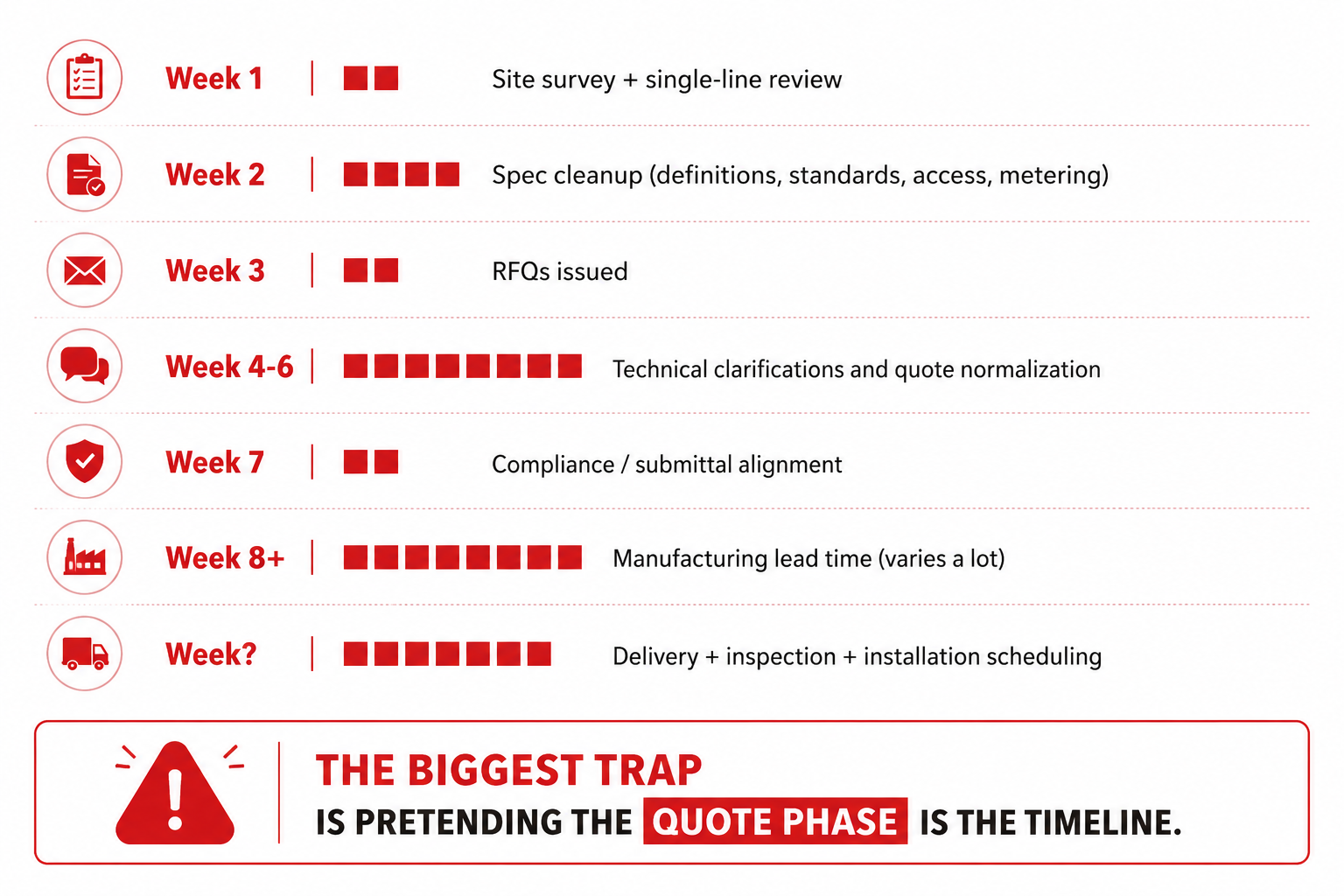
The biggest trap is pretending the quote phase is the timeline.
It is not.
The quote phase is just the beginning.
For the latest available details, check the official page directly.
Operations Planning, Spare Parts, and Code-Driven Delays
This is the part most DIY-minded people skip because it feels boring.
It is not boring when a breaker trips on a Friday and the replacement is 10 weeks away.
What spare parts I decided to stock for my industrial panel boards
I did not try to stock a full duplicate system. I stocked what would actually reduce downtime.
My list was based on failure impact and replacement lead time, not just price.
My practical spare parts list
| Category | What I stocked | Why |
|---|---|---|
| Protection devices | Selected spare breakers/trip units (critical feeders only) | Long lead items can stop operations |
| Control power | Control fuses, miniature breakers, relays | Cheap, fast failures, high downtime impact |
| Indication / interface | Pilot lights, selector switches, contact blocks | Small parts fail more often than expected |
| Consumables | Lugs, ferrules, labels, terminal markers, glands | Field fixes become cleaner and faster |
| Power quality / monitoring | Spare meter CTs (if custom sizes) or at least sourcing plan | Metering failures slow troubleshooting |
| Cooling / enclosure | Fans, filters, thermostats | Heat-related nuisance failures |
| Documentation | Printed as-built drawings + device list | The most ignored “spare part” |
I also kept a parts cross-reference sheet with manufacturer part numbers and acceptable alternates. That sheet saved me twice.
How compliance requirements affected my circuit breaker procurement timelines
This topic hit me harder than I expected.
I assumed breaker procurement was just a purchasing task. It is not.
It is a compliance and documentation task too.
If the breaker is part of a listed assembly, I cannot casually substitute a “close enough” device at the last minute without checking assembly and listing implications. UL’s programs for panel shops and assemblers repeatedly emphasize qualified personnel, design scope, and controlled use of listed/recognized components within defined parameters.
That means compliance affects timeline in at least three ways:
- Submittal and approval time
- Approved component availability
- Substitution review time
Once I accepted that, my procurement planning got much more realistic.
How regional codes affected my load center and panel selection
This part is less exciting, but it is where many projects get delayed.
I learned not to assume “US code” is one uniform field condition.
The NEC is the national installation code framework, but local adoption, utility requirements, and AHJ interpretation can affect what is acceptable in practice. I stopped relying on assumptions and started confirming the adopted code edition and local requirements before finalizing selections.
That single habit prevented one wrong enclosure choice in an outdoor service area.
You can review the original source here to verify the technical details.
The Final Installation and Commissioning Lessons from My DIY Journey
By the end of the project, the physical work was still hard, but the decision-making became much cleaner.
I had gone from “I need a panel” to a real, defensible plan:
- Main distribution handled by the appropriate assembly class
- Branch distribution separated properly
- Control panels treated as control panels, not generic power cabinets
- Standards mapped before procurement
- Spare parts planned before startup
The best part was not just passing inspection.
It was walking into the electrical room six weeks later, adding a feeder revision, and realizing the system was actually serviceable because I had planned for access and expansion.
That was the moment the extra effort paid off.
My biggest lesson is simple:
If you are doing a serious upgrade, do not start with brand names. Start with system role, standards, and operating reality.
That order saves money, time, and stress.
Conclusion about Safe US-Compliant Power Distribution
This project taught me that electrical panels, switchboards, and switchgear are not just vocabulary differences. They represent different design intents, standards, and operational consequences.
As a DIY-minded builder, I still value hands-on work. But on power distribution projects, I now treat selection as an engineering process first and a shopping process second.
If I had to summarize the whole journey in one line, it would be this:
The right assembly is the one that matches the job, the code path, and the maintenance reality, not the one with the most impressive brochure.


Rate this article
Choose a rating from 1 to 5 stars.
No ratings yet